Sustainability
A change of focus from the EU – from reporting to action

The scope of reporting has been proposed to be reduced in order to free up time and resources for measures and innovation, increased competitiveness and the green transition. That's good news!
Use resources on measures that have an effect
Over the past year, there has been a lot of attention on the new sustainability directive from the EU, CSRD (Corporate Sustainability Reporting Directive) The directive entailed significant reporting in the area of sustainability for over 1200 Norwegian companies. This is now reduced to about 200 companies.
The requirement is now being reduced through what is called the Omnibus package (see fact box). All in all, this is good news for small and medium-sized companies, which can now focus their resources on measures that benefit and have an effect in the transition.
Continued reporting?
With reduced requirements for reporting on sustainability information - more people were stumped - should we stop working with sustainability now?
The answer is no. Climate change and the need for restructuring are not going away. Although reporting is not required by law, it will be a competitive advantage to have clear and good information about the company's risks, opportunities and impact on climate, the environment and social conditions. This will help to be transparent and build trust. With the insights gained through reporting, companies can make good strategic choices, which help strengthen companies' resilience and competitiveness in the face of constant change.

Reporting through the use of voluntary standards
Large companies, banks, finance and insurance companies are examples of stakeholders that will continue to request sustainability information, but the EU also limits what information is allowed to be requested from small and medium-sized enterprises.
To solve this, a voluntary standard for sustainability reporting, namely VSME (Voluntary Sustainability Reporting Standard for non-listed SMEs), has been published. It is a good tool that helps companies report on what is important in order to be able to respond to demands from larger customers and stakeholders in the future. Both Accounting Norway and Eco-Lighthouse are now working to update their tools, NSRS and LUMA in line with the new voluntary standard.
Billions for innovation
Although the reporting requirements are becoming smaller, the drivers for sustainability work are not less. At the same time as the European Commission proposed easing sustainability reporting, it also launched the "Clean Industrial Deal" that will help speed up investment and engagement among companies in Europe.
With the Clean Industrial Deal, the European Commission will spend up to €500 billion by 2030 on new renewable energy technologies, circular economy and cuts in industrial emissions. The goal is to strengthen Europe as a sustainable industrial base, and maintain the EU's competitiveness, and reduce dependence on fossil fuels.
Drivers for business
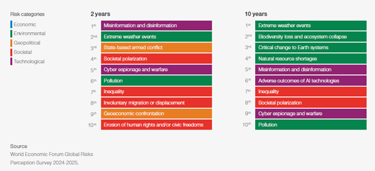
The drivers for continuing sustainability work are also provided by the World Economic Forum's annual global risk report, in which 900 business leaders around the world rank the top ten risk factors they believe will affect the world in the 2- and 10-year future:
Disinformation, extreme weather and the risk of armed conflict are the top three in the short term, while in the long term, climate-related factors such as extreme weather, biodiversity loss and ecosystem collapse, critical changes on the planet and natural disasters are considered to be the biggest risk drivers for business.
The EU Green Deal and the Clean Industrial Deal are measures that will reverse the trend by strengthening competitiveness, while at the same time ensuring sustainable growth. The goal is for more companies to adopt circular business models, cut emissions and make Europe more self-sufficient - among other things by investing in renewable energy.
Create added value for your business
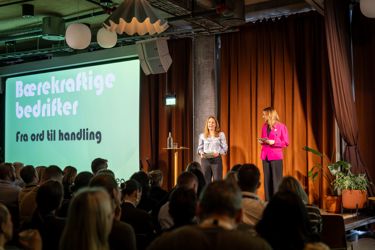
During this year's conference Sustainable companies – from words to action, the topic was sustainability as a management tool for the board and management, and how sustainability reporting can create added value for your business strategically.
Watch the conference in recording
You can also check out our sustainability portal. There you will find tips and advice for practical work with sustainability.
Go to the Sustainability Portal
Are you wondering what is relevant to your industry and business? Our advisors are here for you – contact us and we will help you with your sustainability work.
This is the case:
Through its Competitive Compass, the EU highlights the goal of improving Europe's competitiveness and at the same time supporting Europe's sustainable transition by speeding up innovation and implementation of measures, instead of spending valuable resources on reporting and bureaucratic processes.
The omnibus package means that 80 percent of companies are removed from mandatory reporting of the sustainability directive CSRD. This represents a reduction from 1,200 to approximately 200 Norwegian enterprises.
- A two-year postponement for companies that are initially covered from FY 2025 and 2026 (so-called waves 2 and 3), to FY 2027 and 2028. In practice, this means that if you have less than 1000 employees and were part of wave 2 or 3, you will not be subject to the reporting obligation.
- The limit for covered enterprises is raised to large enterprises/parent enterprises in groups with more than 1000 employees.
- Only data covered by the voluntary standard VSME can be required from non-reportable entities in the value chain
- Reduction in the number of (qualitative) data points, as well as clarifying what are voluntary reporting points
- Moderate attestation is made a permanent requirement
Interested in reading more?
- The Norwegian Association of Public Accountants has very good sides on the topic
- EU regulations - get an overview of the status of EU and Norwegian legislation
- The Norwegian Environment Agency has good pages about the circular economy and the work in Norway
Contact Customer Service at Sparebanken Møre
Just contact us with your questions. Below you will find the information you need to contact us via chat or phone. Schedule a meeting with an advisor here.


